
How the body holds emotions and tension
Friends, recently I sent a Deep Research request to ChatGPT to help structure Wilhelm Reich’s approach.
His ideas are scattered across different works, but in my view, the depth and direction of his research deserve special attention.
For me, Reich was one of those people who began exploring the connection between Body, Emotions, and Psyche very early — and very boldly.
He became one of the key precursors of body-oriented psychotherapy and strongly influenced many approaches that emerged later.
The research ended up being around 27 pages long. For those who want to dive deeper into Reich’s ideas and methods, I recommend it — AI did a pretty good job of structuring and bringing everything together.
Link to the research:
https://drive.google.com/file/d/1HkTZkHhqvTjO46EFFLhP4GWi_lzr2T-F/view
What is all of this actually for?
For me, first of all, it is about clearing consciousness through the body — allowing old, blocked, and once-unprocessed emotions to be lived through.
I often see the body as a kind of “memory flash drive”: habitual tensions, defensive reactions, and unfinished emotional processes can remain stored there for years.
This becomes especially noticeable during periods of strong inner and outer change.
Things that we were once able to ignore suddenly begin to manifest quite literally through the body.
Sometimes so strongly that ignoring them becomes difficult.
And why would we?
We can begin to slowly untangle some of it ourselves 😜
Of course, the research recommends doing deeper work with a therapist. At the same time, it seems to me that many people today already have enough body awareness and sensitivity to explore some gentler practices on their own.
But common sense matters here: intense traumatic reactions, panic states, dissociation, or severe emotional episodes are better not forced through with intensive practices when you are alone.
I would use Reich’s approach primarily as a map for observing the body.
Personally, I combine this kind of work with dance and dynamic meditation.
And that’s where it gets 🔥
By the way, if anyone is interested and lives in Tenerife, write in the comments.
We can get together, and I can lead a group Pulsations practice.
🧠 Who was Wilhelm Reich?
In very simple terms:
Wilhelm Reich was a psychoanalyst and one of the early researchers of the bodily dimension of the psyche.
He noticed that psychological defenses are expressed not only through thoughts and behavior, but also through persistent muscular tension, breathing, posture, and patterns of movement.
He used the concept of muscular armor to describe this.
The idea was that a person can chronically “hold” certain reactions in the body.
This can affect:
- breathing;
- emotional expression;
- voice;
- sexuality;
- movement;
- the ability to feel;
- contact with oneself and other people.
Reich described 7 major segments of muscular armor, arranged from top to bottom — from the eyes to the pelvis.
🔹 Reich’s 7 armor segments
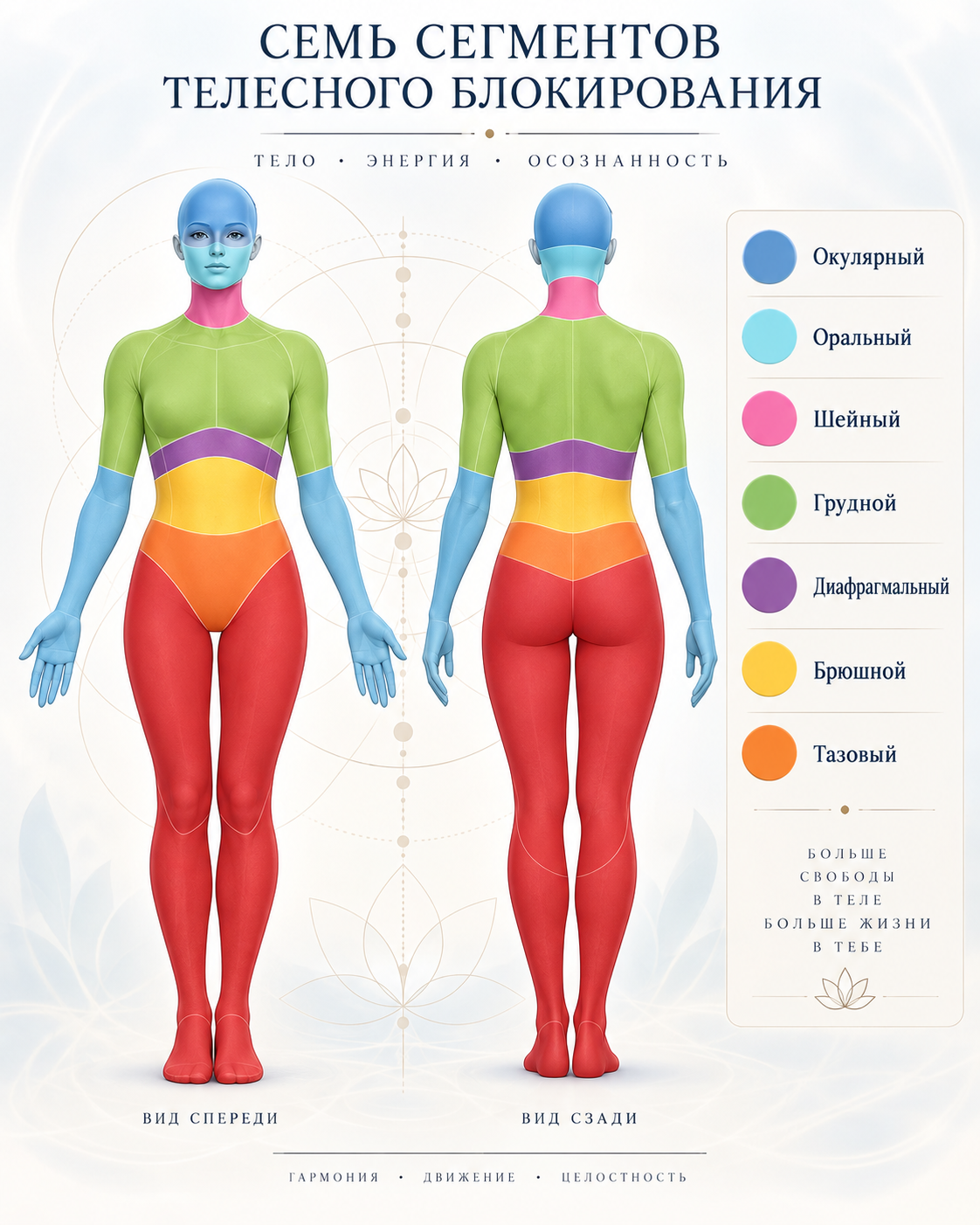
1️⃣ Ocular segment
Eyes, forehead, area around the eyes
Associated with:
- gaze;
- tears;
- expression of fear;
- contact with what is happening.
With strong tension, the gaze can become fixed or “frozen.”
2️⃣ Oral segment
Mouth, lips, jaws
This area may hold:
- crying;
- the need for support;
- tenderness;
- anger;
- jaw tension.
3️⃣ Cervical segment
Neck and throat
It may be associated with holding back:
- screaming;
- crying;
- words;
- protest;
- the desire to say “no.”
4️⃣ Thoracic segment
Chest, shoulders, arms
The connection between emotions and breathing is especially noticeable here.
A person may literally reduce the depth of their breathing in order to feel less.
This segment is often associated with:
- love;
- grief;
- tenderness;
- anger;
- the impulse to move closer or push away.
5️⃣ Diaphragmatic segment
Diaphragm, solar plexus
One of the key areas influencing the depth of breathing.
Reactions connected with the following may appear here:
- fear;
- rage;
- control;
- holding back intense feelings.
6️⃣ Abdominal segment
Abdomen
The abdomen often becomes an area of chronic holding and tension.
Reactions of anxiety, vulnerability, and anticipation of danger can be especially noticeable here.
7️⃣ Pelvic segment
Pelvis, buttocks, legs
Reich paid particular attention to this area.
It is associated with:
- sexuality;
- pleasure;
- movement;
- spontaneity;
- the ability to let go of control.
🔮 And what about the chakras?
This is where things become especially interesting for me.
If we look at Reich’s map of bodily segments and then at the traditional chakra system, we can indeed notice certain anatomical and symbolic parallels.
But I would not say that Reich “scientifically discovered the chakras using Western language.”
Rather, two very different traditions observed the human being through their own systems of coordinates — and in some places these maps overlap in fascinating ways.
Approximately like this:
1️⃣ Ocular segment ↔ Ajna
The area of vision, perception, and focus of attention.
2️⃣ Oral and cervical segments ↔ Vishuddha
Voice, expression, the ability to speak and manifest oneself.
3️⃣ Thoracic segment ↔ Anahata
Breath, chest, love, grief, intimacy.
4️⃣ Diaphragmatic segment ↔ Manipura
Solar plexus, will, fear, action, control.
5️⃣ Abdominal segment ↔ Svadhisthana
Sensitivity, emotions, vulnerability, embodiment.
6️⃣ Pelvic segment ↔ Muladhara + Svadhisthana
Safety, sexuality, pleasure, connection with the earth and the body.
✨ What I like here is the underlying idea itself:
When a person is chronically contracted, breathing, movement, sensitivity, and vitality decrease.
As tension gradually releases, more space becomes available for breathing, feeling, and movement.
🌀 When the armor begins to release
During deep bodywork, different reactions may arise:
- trembling;
- deep inhalations and powerful exhalations;
- tears;
- laughter;
- an urge to make sound or scream;
- warmth;
- tingling;
- spontaneous movements;
- wave-like movements of the body and pelvis.
I would not automatically call every such reaction “healing.”
But often it may indicate that the nervous system and the body are beginning to move out of their habitual pattern of holding.
Interestingly, some modern body-oriented approaches also work with similar phenomena.
For example:
- Somatic Experiencing, developed by Peter Levine, works with the bodily experience of traumatic stress and restoring the nervous system’s capacity to complete defensive responses;
- TRE uses neurogenic tremoring as one mechanism of bodily discharge;
- modern models of the autonomic nervous system explore transitions between mobilization, defensive states, and states of safety.
The approaches are different.
The language is different.
But attention keeps returning to the body.
💚 What I personally take from Reich
Something very simple:
an emotion is not only a thought about what I am feeling.
It is also breath.
Muscle tone.
The impulse to move.
Sound.
Gesture.
Body posture.
And if we hold something back for years, the body gradually learns to hold it with us.
Which means that sometimes the path toward greater freedom lies not only through understanding...
But also through allowing the body once again
to breathe, move, sound, and feel.
📌 P.S.
I have also taken a lot for my own practice from Anisha Dillon’s book Tantra — The Path to Bliss.
I like the way she brings together Reich’s bodywork, Alexander Lowen’s approaches, and Osho’s dynamic meditations.
I recommend it to anyone interested in deep work through the body, movement, breath, and emotions.